The dances draw inspiration from local products like the “Gramulîn”, typical Galliate’s cake full of raisin and covered with sugar grains and the “Baragiêu” a wine produced in the vineyards called “Baraggia” on the rises located in the suburbs of Galliate, facing the Ticino’s valley; from female past labours and
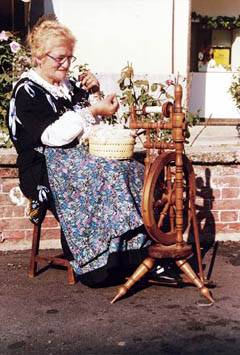 handworks like weaving “ A Bicòca e i firèlu “ ; from children’s game like the top “ A Pêrla” and moreover from
happiness events or tales of genial tricky people like “L’umbrèla di Pidü” and the old strange
handed-on story of the cock of Galliate “ I Gà da Gajà” the symbol of our village.
handworks like weaving “ A Bicòca e i firèlu “ ; from children’s game like the top “ A Pêrla” and moreover from
happiness events or tales of genial tricky people like “L’umbrèla di Pidü” and the old strange
handed-on story of the cock of Galliate “ I Gà da Gajà” the symbol of our village.
In their repertoire also Piedmontese dances such as Giga and Courenta. Representing Italy in trips abroad, the group also presents 2 quadrilles.
The performed sketches propose pictures of common popular life, like “ Catarinîn” the odd tale of a just-married couple during their first night set in times gone by , “ Piänta piantà ‘nt i pra” a woodcutter’s nonsense rhyme and the representation of ancient professions now in extinction such as the magnano (the tinsmith), the mulita (grinder), the farmer who makes the thread for the ranza to cut the grass, the woodcutters who sing a nursery rhyme while they cut the wood, the hand-picking of the corn and the carter, who cracked the whips near the horses' ears to increase the speed of the transport. (the whips crack only if the speed of sound is reached)
The singing repertoire includes dialectal pieces from Galliate and popular Piedmonts songs.
The full repertoire supposes the taking part of the public in many occasions; the performance may last till over two hours, ideal for covering a day, the afternoon or evening of a festival or other event. With the help of live instruments, cover with quality parades and markets or fairs, with performances at every point requested or reduced to a nice "entrance" of circumstance.
The group performs with live music, integrated by a microphone amplification system that allows to the group a full autonomy in every circumstance, even at night, by developing the lighting, in the performing area, with two 500 watt spot lamps.
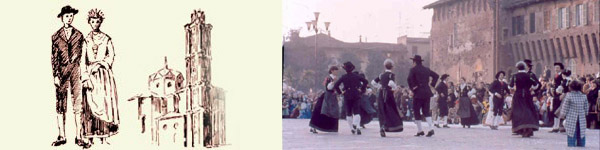
 Galliate is a small town, situated two kilometres far from Ticino river, now natural border between
Piedmont and Lombardy, in the past boundary line between the competitors towns of Novara and
Milan.
Old quarrels kept Galliate apart from Novara and let it form an alliance with Visconti and Sforza
families, both Dukes of Milan.
The neighbourhood of Milan as well as its domination are at the origin of the so many connections
among the villages on the two banks of Ticino.
Galliate is a small town, situated two kilometres far from Ticino river, now natural border between
Piedmont and Lombardy, in the past boundary line between the competitors towns of Novara and
Milan.
Old quarrels kept Galliate apart from Novara and let it form an alliance with Visconti and Sforza
families, both Dukes of Milan.
The neighbourhood of Milan as well as its domination are at the origin of the so many connections
among the villages on the two banks of Ticino.
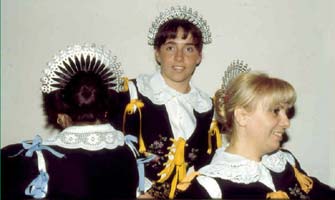
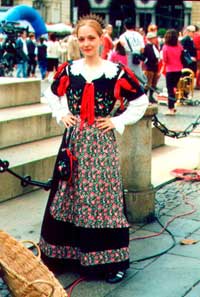 The costume of the group of the 18th century style, shows traces of these links between Milan and
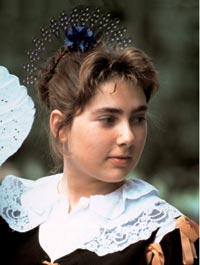
Galliate. The most remarkable detail of the costume is the ornament wore on the head by the ladies.
In the neighbouring region it consists of many single big pins (called small swords) on the contrary,
what we used in our village, was one block of pins, but in both cases it appears like a little crown,
ready to put up hair.
The well-off families ordered this ornament of silver filigree, the humble classes used less
expensive materials.
The costume of the group of the 18th century style, shows traces of these links between Milan and
Galliate. The most remarkable detail of the costume is the ornament wore on the head by the ladies.
In the neighbouring region it consists of many single big pins (called small swords) on the contrary,
what we used in our village, was one block of pins, but in both cases it appears like a little crown,
ready to put up hair.
The well-off families ordered this ornament of silver filigree, the humble classes used less
expensive materials.
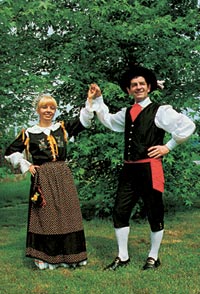
 The men's costume is in black light-weight cotton and includes the waistcoat and trousers, buttoned
to the knee with golden buttons. The shirt is white with wide sleeves; the cummerbund and the
foulard on the neck are of red cloth. The costume is completed with white long cotton socks till the
knees, black shoes with big golden buckles, broad-brimmed hat with a red ribbon and a white tassel.
The men's costume is in black light-weight cotton and includes the waistcoat and trousers, buttoned
to the knee with golden buttons. The shirt is white with wide sleeves; the cummerbund and the
foulard on the neck are of red cloth. The costume is completed with white long cotton socks till the
knees, black shoes with big golden buckles, broad-brimmed hat with a red ribbon and a white tassel.