|
L'ARROTINO - The knife grinder - Song 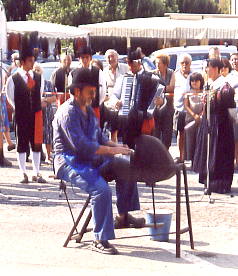 When the knife-grinder shouted " ' L moulita! 'l moulita! " all the women,
who had some scissors, knives of other items to be sharpened, surrounded him and waited for
their turn to be attended without pushing. As a matter of fact, the skilful handling of so
many blades commanded respect and the knife-grinder, moving from court to court, after having
shouted his arrival, worked in silence sharping everything excepting tongues, that were, as he
was always telling, already sharp.
The equipment was very simple. On a solid wooden support was based the grindstone, it
was clasped to some tools linked to a pedal and, as by magic, the foot alternative movement
up and down became a rotative motion. That's it! The song tells about a young boy, a
knife-grinder like is father. They both go around the world, their cosy world earning
some money. Their life is simple, approaching plain people, eating natural food and
drinking good wine.
Father and son with rubicund faces are the health portrait.
When the knife-grinder shouted " ' L moulita! 'l moulita! " all the women,
who had some scissors, knives of other items to be sharpened, surrounded him and waited for
their turn to be attended without pushing. As a matter of fact, the skilful handling of so
many blades commanded respect and the knife-grinder, moving from court to court, after having
shouted his arrival, worked in silence sharping everything excepting tongues, that were, as he
was always telling, already sharp.
The equipment was very simple. On a solid wooden support was based the grindstone, it
was clasped to some tools linked to a pedal and, as by magic, the foot alternative movement
up and down became a rotative motion. That's it! The song tells about a young boy, a
knife-grinder like is father. They both go around the world, their cosy world earning
some money. Their life is simple, approaching plain people, eating natural food and
drinking good wine.
Father and son with rubicund faces are the health portrait.
|
|
LO STAGNINO - The Tinman - Song and sketch 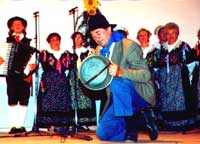 The tinman was very popular in Italy till the fifties. In the fixed days
of the month he arrived with his equipment and, by shouting, he invited to approach all
the women, who needed to repair a pot or other items. Usually he repaired immediately
everything but, when the damage was too bad, he took the pots home and brought them back
the next time. Normally everything was easy but sometimes the tinman had some love affairs.
The tinman was very popular in Italy till the fifties. In the fixed days
of the month he arrived with his equipment and, by shouting, he invited to approach all
the women, who needed to repair a pot or other items. Usually he repaired immediately
everything but, when the damage was too bad, he took the pots home and brought them back
the next time. Normally everything was easy but sometimes the tinman had some love affairs.
|
|
PIÄNTA PIANTÀ ‘NT’I PRA - Song and sketch 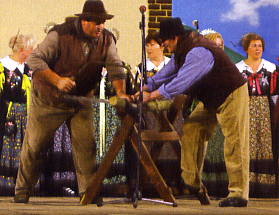 This is a good example of iterative song in Gallite's dialect that in its tradition
enumerates some similar songs. This one, conceived by a wood-cutter , tells about a tree that
stand in a meadow and it was really unique with its trunk, branches, twigs and leaves ones
connected to the others and supporting a intertwined nest up, among the leaves.
This rigmarole is very easy but the text may last forever, it depends on the singer's
imagination: it seems that a wood-cutter sang enough to prepare many quintals of woods.
This is a good example of iterative song in Gallite's dialect that in its tradition
enumerates some similar songs. This one, conceived by a wood-cutter , tells about a tree that
stand in a meadow and it was really unique with its trunk, branches, twigs and leaves ones
connected to the others and supporting a intertwined nest up, among the leaves.
This rigmarole is very easy but the text may last forever, it depends on the singer's
imagination: it seems that a wood-cutter sang enough to prepare many quintals of woods.
|
|
THE CARTERS WITH THE WHIPS - sketch 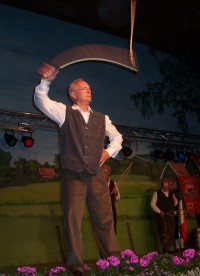 Up to the middle of the past century, in Galliate, you could find the carters, that with their
chariots hauled by horses, transported the cloth from the mill, in the centre of town, to the
printing or wrapping factory, situated in the outskirts of town or in neighbouring villages.
Up to the middle of the past century, in Galliate, you could find the carters, that with their
chariots hauled by horses, transported the cloth from the mill, in the centre of town, to the
printing or wrapping factory, situated in the outskirts of town or in neighbouring villages.
To spur the horses they used the whips. The precise recovery of this trade, by now all but disappeared with the advent of motor vehicles, left us with the memory of the crack of the whips. |
|
THE RANZA - Song and sketch 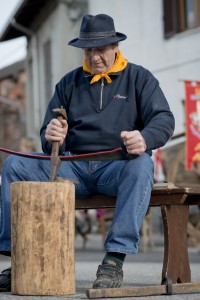 Ranza, an Italian word for "hay scythe", is a tool used for cutting hay, wheat and grass.
Nowadays only few people use it, as it has been substituted by mechanical tools of every dimension:
from the small lawnmower to the huge harvester.
Ranza, an Italian word for "hay scythe", is a tool used for cutting hay, wheat and grass.
Nowadays only few people use it, as it has been substituted by mechanical tools of every dimension:
from the small lawnmower to the huge harvester. When everything was cut using our arms, the ranza was very important and effective as long as the blade cuts properly and the blade thread holds together: a whetstone could help to keep it sharp. In order to restore the used blade thread, the ranza was put on a nail-shape anvil sticked into a log or into the ground and then beaten by a little hammer. This procedure required lots of technique: the blade was beaten from the widest part to the top. The wisest craftsmen sharpened them directly in the fields, and other one sharpened them on the barnyard in the early morning, for the pleasure of the neighbourhood participating to it and to the work that everybody will do during the day. During the show, the sharpening procedure is done according to the tradition and along with the popular song “La Ranza”. |
|
THE PICHER - Song and sketch The indian corn, or maize, is a graminaceous plant originating from Central America, for a long time it has been cultivated in north Italy where the inhabitants are called after the most famous food deriving from the maize and are named “Polentoni”. The maize needs a lot of works such as abundant manuring, hoeing and earthing up; nowadays the maize is cultivated using big machinery during every working stage, some time ago the whole work was done by hand and, after the harvesting, the corn-cobs in their corn-husk were piled up waiting to be husked, tied up and hung on the railings of the cottages to dry. Folk songs in all dialects of the Po valley are dedicated to maize and polenta. In particular a piedmontese song tells the harvesting and maize-stripping work; this song explains then that, after the hara work, while the polenta is cooking people warm themselves by the fire and love stories between daring boys and beatiful girls originate. |
|
LA PIEMONTESINA - Song and sketch  This song native of Turin is, since many years, part of the Italian popular
tradition and represents all Piedmont. It tells the story of two young students in
love but at the end of their studies they have to leave and they say goodbye to each
other keeping in their hearts the remembrance of their love.
This song native of Turin is, since many years, part of the Italian popular
tradition and represents all Piedmont. It tells the story of two young students in
love but at the end of their studies they have to leave and they say goodbye to each
other keeping in their hearts the remembrance of their love.
|
|
LA MARIOLÀ- Song This piece is sung in Piedmonts dialect and it tells about a man who decided to get married. He hadn't got any fiancé so he started looking for an ideal woman; in the text he describes the characteristics that the wife should have but, as he cannot find such a woman, he decides that is better to enjoy life and to drink wine. |
|
LA RISAIA - Song 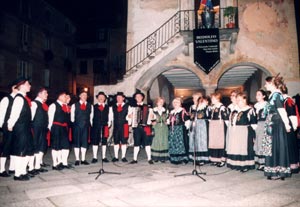 A very typical song from lowlands of Novara and Vercelli, where the
rice production is also the primary culture and the main job was the rice-pickers (mondina).
Today this female work has been replaced by machines and modern equipments, but
the "mondina" still remains alive in everybody's mind and plays an important role
in our tradition.
A very typical song from lowlands of Novara and Vercelli, where the
rice production is also the primary culture and the main job was the rice-pickers (mondina).
Today this female work has been replaced by machines and modern equipments, but
the "mondina" still remains alive in everybody's mind and plays an important role
in our tradition.
|
|
LA CRICCA - The gang - Song This is a very famous song from Turin valleys. The protagonist of this piece is a very happy gang of merry fellows, fond of mountain and good wine. The main purpose of the gang is to forget sadness and life's problems by singing. |
|
CATARINÎN - Song and sketch 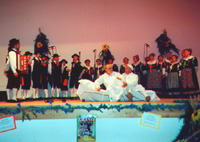 This typical sketch of Galliate is the funny tale of a just-married
couple during their first night of marriage. Following past customs, the couple is
finally alone for the first time: the husband is very anxious and he immediately
goes to bed, but the wife, very shy and embarrassed finds thousand excuses not
to lie down until the new day arrives, without having satisfied her husband.
This typical sketch of Galliate is the funny tale of a just-married
couple during their first night of marriage. Following past customs, the couple is
finally alone for the first time: the husband is very anxious and he immediately
goes to bed, but the wife, very shy and embarrassed finds thousand excuses not
to lie down until the new day arrives, without having satisfied her husband.
|
|
I MATI DA GAJÀ - The girls form Galliate - Song and sketch This is a nice rigmarole of our town Galliate that is composed by many districts. The song describes with irony the customs and the defects of the girls of each district. |