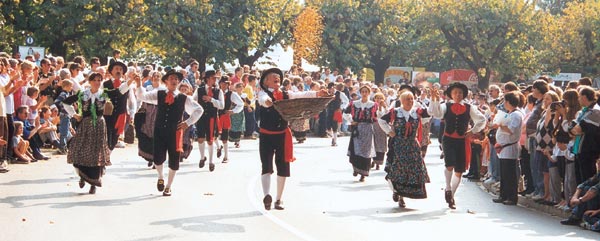
A L’UMBRELA DI PIDÜ - The dance of the umbrellas - Polka
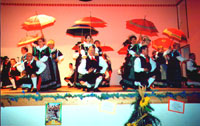 This dance deals with a matter still actual nowadays: the housing problem.
A long time ago a group of jovial and cheerful people decided to find a solution and
they built up a very huge umbrella. It became their house and they were eating, drinking
and singing in happiness under this "roof", forgetting the problems of their life, at
least for a while.
This dance deals with a matter still actual nowadays: the housing problem.
A long time ago a group of jovial and cheerful people decided to find a solution and
they built up a very huge umbrella. It became their house and they were eating, drinking
and singing in happiness under this "roof", forgetting the problems of their life, at
least for a while.
|
IL CANTASTORIE - The story teller - Choreographic dance - Waltz
This is the ballad of a story-teller, who came once to Galliate and
cheered up the people with his nice songs, wandering around roads and squares.
|
VARDA A PÊRLA MÈ CA VÀ - The dance of the spinning top - Polka
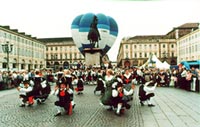 The name "pêrla" means spinning but in Italian it may be a play on words,
not to be misunderstood. The top, together with the "lêpa" and the "scazû" was a healthy
amusement for the old generations. It was played almost everywhere, in squares and on roads.
It was enough to have a whip, a wooden cone and some imagination to spend some nice,
amusing hours. It was so important that Galliate decided to dedicate it a song and later
on even a dance.
The name "pêrla" means spinning but in Italian it may be a play on words,
not to be misunderstood. The top, together with the "lêpa" and the "scazû" was a healthy
amusement for the old generations. It was played almost everywhere, in squares and on roads.
It was enough to have a whip, a wooden cone and some imagination to spend some nice,
amusing hours. It was so important that Galliate decided to dedicate it a song and later
on even a dance.
|
MANGHÎN E MANGHINA DI GALLIATE - Waltz
This is typical dance employed, because of its own feature, to introduce
the dancers to the public during performances. Happiness and cheerfulness are
so alluring and inviting in this dance that it has been chosen as good-wishing
dance for the opening ceremony of the International Folkloristic Festival,
taking place in Galliate every two years.
A couple of each folk group attending the meeting is then invited to perform
this beginning dance together with our group.
|
L’ARCA ‘D NUÈ- Galliate's wine dance - Waltz
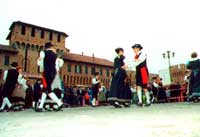 Galliate has got its local wine-making. The "Baragiêu" is a red, less alcoholic
wine produced from American grapes, exalting its taste. A long time ago, this wine was
much diffused but it is still produced in small quantities. Although not world-wide known,
it is locally much appreciated and gives warmth and liveliness to any popular feasts.
The rhythm set in this dance is a sweet memory of the old wine-pressing, as it was a long
time ago, when grapes were crushed by feet
Galliate has got its local wine-making. The "Baragiêu" is a red, less alcoholic
wine produced from American grapes, exalting its taste. A long time ago, this wine was
much diffused but it is still produced in small quantities. Although not world-wide known,
it is locally much appreciated and gives warmth and liveliness to any popular feasts.
The rhythm set in this dance is a sweet memory of the old wine-pressing, as it was a long
time ago, when grapes were crushed by feet
|
The Ticino's waltz
The Ticino River rises on Saint Gotthard in Switzerland, it forms the Maggiore
Lake and then it flows down running along our village, Galliate and, further on it joins
the Po river.
Many festivals are organized along its banks and this dance is just dedicated to the
Ticino River that, with its clear and fresh water makes Galliate a very important
Italian bathing-river resort.
|
GAJÀ E I SO BUMBÒ - Galliate's cake waltz
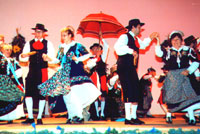 This dance is dedicated to the typical cake baked in Galliate: the "Gramulîn".
This characteristic-shaped cookie is richly full of raisins and covered by a coating
of sugar grains.
Now it is a daily cake but, in past times, it was taken out from the oven only on Saint
Joseph's day, the patron and traditional holiday of Galliate.
This dance is dedicated to the typical cake baked in Galliate: the "Gramulîn".
This characteristic-shaped cookie is richly full of raisins and covered by a coating
of sugar grains.
Now it is a daily cake but, in past times, it was taken out from the oven only on Saint
Joseph's day, the patron and traditional holiday of Galliate.
|
ALLEGRO PIEMONTE - Cheerful Piedmont - Choreographic Polka
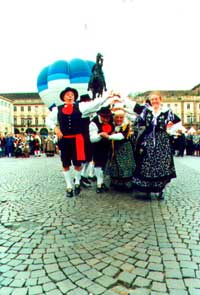 From an old Piedmont's piece takes its origin this cheerful and lively dance.
A very quick rhythm allows the performance of very choreographic steps with many little
jumps and pirouettes while the dancers intertwine and exchange in different choreography
forming circles and stars. During the dance there aren't any fixed arranged couples,
but every dancer changes continuously the partner by developing different movements.
The good result of this dance is possible only with a perfect synchronism of all the
dancers, during this incessant alternating.
From an old Piedmont's piece takes its origin this cheerful and lively dance.
A very quick rhythm allows the performance of very choreographic steps with many little
jumps and pirouettes while the dancers intertwine and exchange in different choreography
forming circles and stars. During the dance there aren't any fixed arranged couples,
but every dancer changes continuously the partner by developing different movements.
The good result of this dance is possible only with a perfect synchronism of all the
dancers, during this incessant alternating.
|
LA SCOPA - The broom - Waltz
Till the middle of last century, during the summer months, many rice-pickers,
mostly young women from all Italy, worked in rice-fields. In the evening they all
gathered to dance on the threshing-floor. As many of those young girls and the local
young boys were shy, they thought out a trick to make friends and they used a broom,
as an ideal partner to be exchanged during the dances. Thanks to this non-stop exchanging
of ladies, they had the opportunity to know each other. The one, who held the broom, when
the music stopped, had to play a forfeit.
|
IL BALLO DEL CERCHIO - The dance of the circle - Quadrille
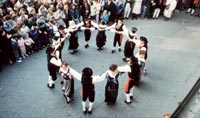 This dance represents the fusion in a single circle of the southern
and northern folklore: actually the music coming from the South is merged with
the most characteristic dance from the North, exactly the circle.
This dance represents the fusion in a single circle of the southern
and northern folklore: actually the music coming from the South is merged with
the most characteristic dance from the North, exactly the circle.
|
Tyrolese Waltz
In August 1985 the Folk Group " Manghin e Manghina" was present at the " First
World Festival of Folk dances " that took part in Münich.
During our stay, we had a pleasant and friendly relationship with an
Austrian group, with whom we sang, played and danced: the result of this nice twinning
is just this dance.
The dance steps learned are presented as a reminder of that wonderful day.
|
LA QUADRIGLIA - The quadrille
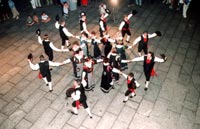 The music is characteristic of Southern Italy; the dance is cheerful
and rich of turns, twirls and warmth: it looks really like its land of origin.
We dedicate it to all the people living among us but being away from home due to
work or family reasons.
The music is characteristic of Southern Italy; the dance is cheerful
and rich of turns, twirls and warmth: it looks really like its land of origin.
We dedicate it to all the people living among us but being away from home due to
work or family reasons.
|
THE JIG
JIG can be considered as the most famous and the most ancient Irish song widespread
in Great Britain thanks to the migrations from the native island.
Since the beginning of 1900 jig was very popular in Novara area, and it is still danced in some part of the Piedmont.
It seems that these areas has been acquainted with jig thanks to some English mercenaries who crossed Sesia River
in May 1361 and lorded in these areas until 1363 thank to the German commander Albert Sterz. As soon as the mercenaries
were repelled from Piedmont to Tuscany thanks to Novarese troops, they were known for their several killings,
terrible brutality, dreadful destructions and also for the jig.
|
|
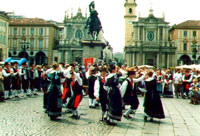 A long time ago, one of the main jobs was spinning the cotton.
In every house there was the "firelu", the tool used for this work and all people
young or old people were able to use it.
The dance starts very slowly and regularly, recalling the economical crisis of
the weaving mills based in Galliate at the beginning of the nineteenth century,
then it speeds up gradually with a cheerful ending, meaning the work new recovery.
A long time ago, one of the main jobs was spinning the cotton.
In every house there was the "firelu", the tool used for this work and all people
young or old people were able to use it.
The dance starts very slowly and regularly, recalling the economical crisis of
the weaving mills based in Galliate at the beginning of the nineteenth century,
then it speeds up gradually with a cheerful ending, meaning the work new recovery.